Posted by Sam McCurdy:
At our meeting on Wednesday, we had a very informative and interesting presentation by Rae McKay, who is the Chair of the Mine Land Rehabilitation Authority Board.
His presentation covered the problems associated with the land rehabilitation of the three mines in the Latrobe Valley, namely Hazelwood, Yallourn, and Loy Yang. These cover 135sq kms of land, of which 40sq kms is the total pit area.
The four generation stations using brown coal from the mines have supplied 90% of Victoria’s power for decades. However, 'Renewables', including solar, wind, hydro, biofuels and others, are at the centre of the transition to a less carbon-intensive and more sustainable energy system. Therefore, the mines are being phased out with Hazelwood closing in 2017, and Yallourn planned to close in 2028.
Further mining is still an option as the brown coal could be used to produce Hydrogen as a fuel, provided the CO2 produced in the process could be removed. The brown coal reserves could last for over 500 years at the current productivity of 60 million tonnes per year.
It was originally planned that Hazelwood would be rehabilitated before Yallourn shut down, but the politics of power generation through 'Renewables' have brought the closures forward significantly. Work on land rehabilitation has not yet commenced at Hazelwood.
To gain a perspective of the magnitude of the task, it has been estimated that to fill the Hazelwood pit with bodies, it would require 3 times the total world population. Rocks, soil and water were considered for rehabilitation purposes, but supplying enough of each is problematic.
Water has been selected as the cheapest option, as it would stabilise the pit walls of the mines creating three lakes. However, the problem is being able to get enough water to fill the pits. The La Trobe valley currently uses 500 gigalitres of water per year. If all this water was diverted to the Hazelwood pit, it would take at least 6 years to fill it.
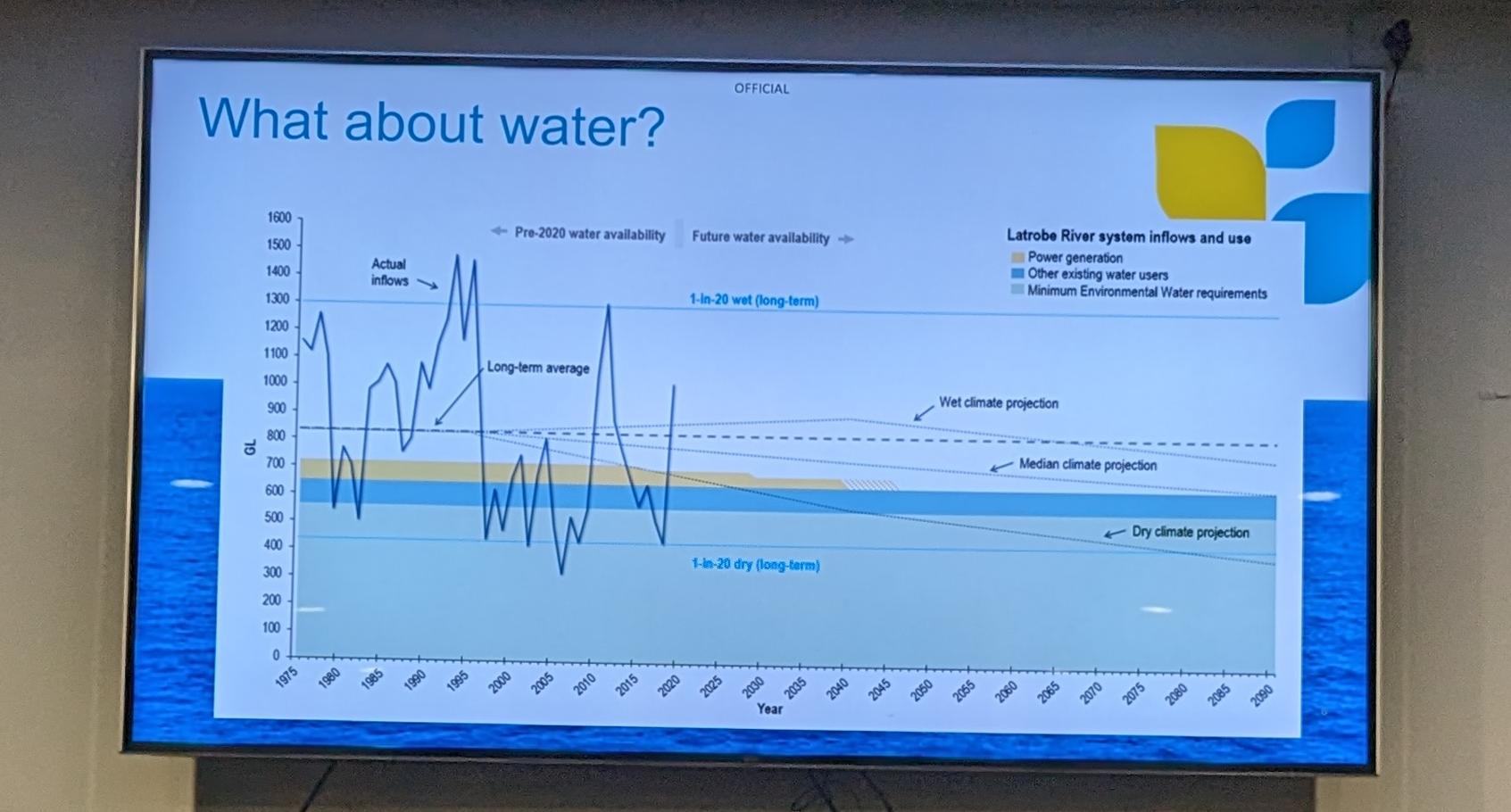
Both State and Federal Governments recognise the importance of water as a resource in Australia and are cautious in its proposed use. This is especially important as the annual rainfall is predicted to fall over the next decades, due to climate change.
The land rehabilitation of the three pits poses a monumental problem and the experts are learning as they go along, as nothing of this magnitude has been experienced before.
Thanks Rae for a very enlightening presentation.