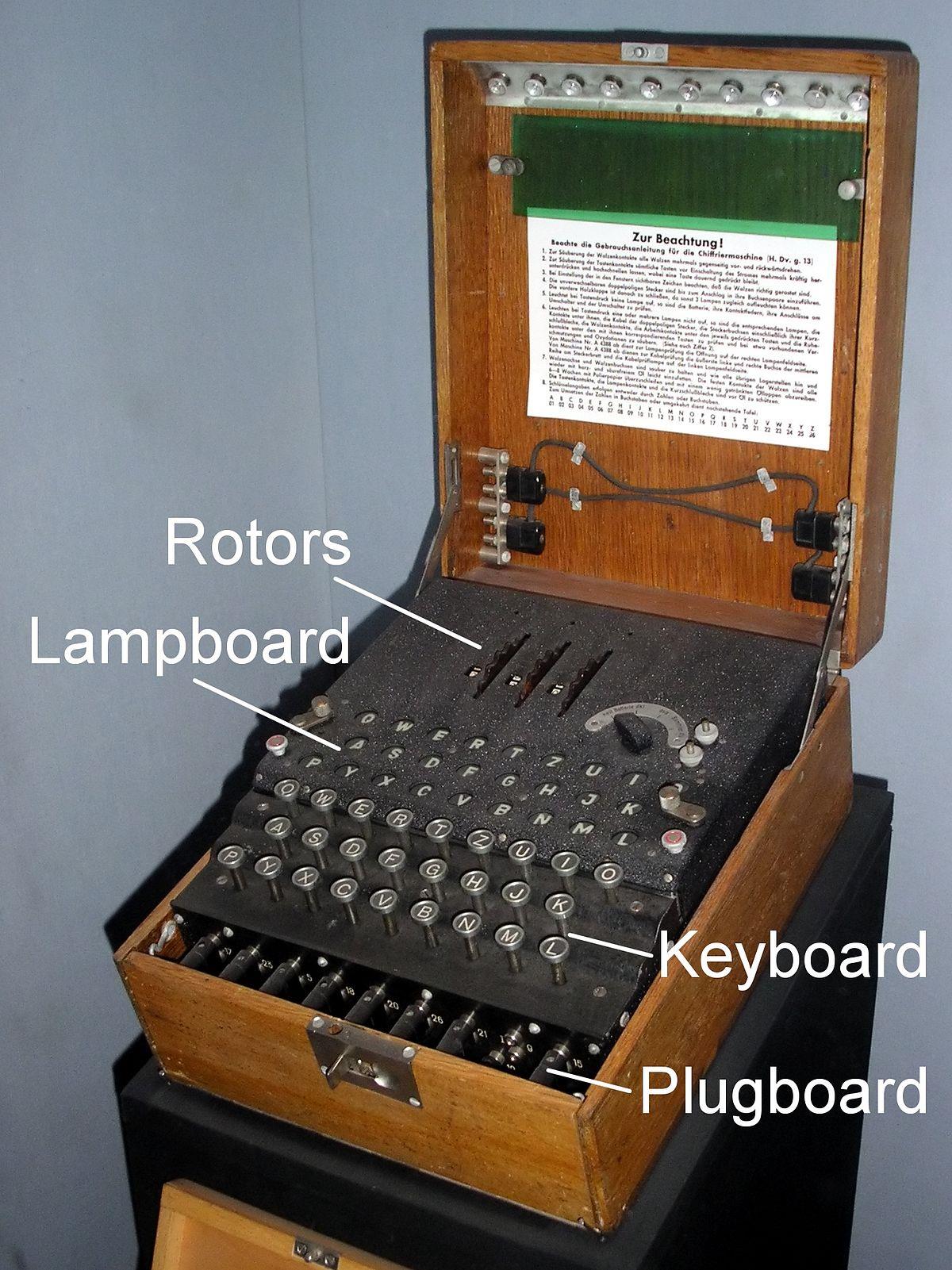
ENIGMA was the codename for the cipher machine developed from a design patented by a Dutchman, Hugo Koch, in 1919. Impressed by its security, which was based on a high level of statistical complexity, the German Army acquired all rights to the machine. It adapted it to the needs of its modern military forces. It became the standard cipher machine for Germany's military services, intelligence agents, and secret police. It was used at all levels, from high command to front-line tactical units, including individual aeroplanes, tanks, and ships. Although Polish mathematicians had worked out how to read Enigma messages and had shared this information with the British, the Germans increased their security at the outbreak of war by changing the cipher system daily, making the task of understanding the code even more difficult.
Breaking the Code: Alan Turing was a brilliant mathematician. Born in London in 1912, he studied at Cambridge and Princeton universities. Before the Second World War, he worked part-time for the British Government’s Code and Cypher School. In 1939, Turing took up a full-time role at Bletchley Park in Buckinghamshire, where top-secret work was carried out to decipher the military codes used by Germany and its allies. Turing’s work at Bletchley was the main focus of cracking the ‘Enigma’ code. Turing, along with fellow code-breaker Gordon Welchman, played a key role in inventing a machine known as the Bombe. This device significantly reduced the work of the code-breakers. From mid-1940, German Air Force signals were being read at Bletchley, and the intelligence gained from them was helping the war effort.
In July 1942, Turing developed a complex code-breaking technique called ‘Turingery’. This method fed into work by others at Bletchley to understand the ‘Lorenz’ cipher machine. Lorenz enciphered German strategic messages of high importance: Bletchley's ability to read these contributed significantly to the Allied war effort. Turing travelled to the United States in December 1942 to advise US military intelligence on using Bombe machines and share his knowledge of Enigma. While there, he also saw the latest American progress on a top-secret speech-enciphering system.
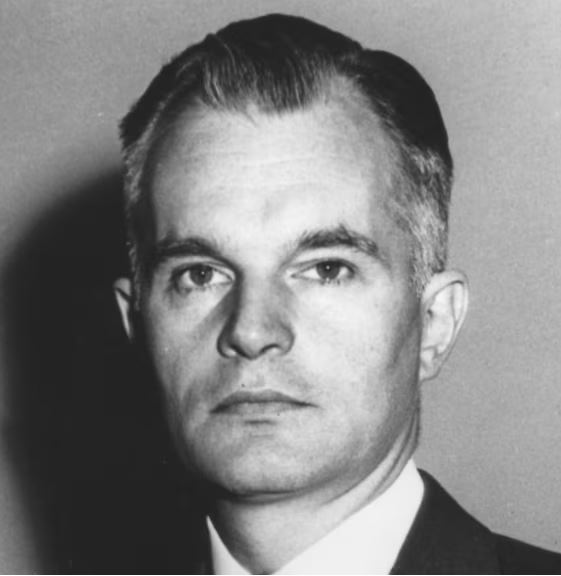
Then Uncle Bob stepped into the picture. Bob Button began his communications, music and writing career at Dartmouth College (Class of 36), where he was a member of the Casque and Gauntlet Honor Society. He went to work for NBC and obtained a law degree in 1939. He was the first NBC employee to be drafted in 1941.
After being drafted, Bob moved through the ranks, most likely because of his law degree and his wit and eventually became a military intelligence officer. He served on General Bradley's G-2 staff and General Eisenhower's Special Forces staff in England, Germany, and France. He was one of the first Americans to work on the Enigma code-breaking project at Bletchley Park, England, where he played an important role in decrypting intelligence messages. It took a while for the British to trust him, but he eventually gained a solid reputation with his British colleagues.
He emerged from the military as a Colonel, earning 2 Bronze Stars and 6 Battle Stars. The military allowed Uncle Bob to play the piano and he often entertained the soldiers and others. By all accounts, he was a talented musician and enjoyed making a party wherever he could. On one occasion a booby-trapped piano almost ended it all, but he managed to survive.
Uncle Bob wrote a book titled Enigma in Many Keys about his military experiences, which I found pretty entertaining considering the certain traits entrenched in the Button lineage. His children (my cousins) convinced him to write a memoir using the letters he wrote to his parents during the war as a reference. What he was doing, for the most part, was top secret, so the letters had to contain only permissible content to ensure his parents did not become unduly alarmed. The only thing that alarmed me about Bob was that he was a Lion, whereas my brothers are Rotarians. Community matters in my family.
After the war, he continued at the forefront of the communications industry with NBC and Voice of America. He also served as a Public Affairs Advisor to the US Ambassador to NATO and Executive Assistant to the Chairman of Communications Satellite Corporation when it first launched the first communications satellite.
There is a lot more to the story, but you can find out more by looking at the links below if you are interested or have time to spare trolling the internet. That is all I have to share on this Anzac Day. I hope you found some of the story interesting and that it brought a different perspective to the aspects of war.
References:
http://www.drewry.net/TreeMill/indiI210.html
https://www.insidevoa.com/a/4498059.html
https://www.iwm.org.uk/history/how-alan-turing-cracked-the-enigma-code
Button, Robert E. (2004). Enigma in Many Keys. iUniverse
