Welcome to our vibrant and relaxed Rotary Club, where community spirit thrives alongside a sense of ease and camaraderie. Picture a place where laughter mingles with purpose and friendships are forged through shared experiences and meaningful endeavours.
The Easter school holidays have led to a pause in our regular meeting program as a number of members are enjoying time away with family.
This week we have planned a wonderful night of wine and cheese tasting at a local Berwick establishment, Lets Unwine, followed by dinner. It’s sure to be an enjoyable night with a good number of members already booked to attend. Why not join us.
April is Rotary Environment Month
As we move into April, we celebrate Rotary Environment Month – a time to reflect on the positive impact Rotary clubs around the world are having on our planet. Please check out the article later in the bulletin about Rotary and Earth Day to hear about a number of environmental projects around the globe.
Looking Ahead: Special Guest Next Week!
Our next regular meeting is on April 23rd where we will have a very special guest speaker, local identity and historian Neil Lucas who will be enlightening us with some local history of Berwick.
As People of Action, Rotarians have been shaping the conversation on the environment for years
Fifty years ago, the first Earth Day was held on 22 April, 1970, launching a wave of action to protect our environment, including the passage of landmark environmental laws in the United States. Other countries soon followed suit. Every year since, the day has been set aside to focus on mobilizing for action to protect our planet.
As people of action, Rotarians have been shaping the conversation on the environment for years, from addressing climate change that threatens entire food systems to fighting pollution that clogs our air and water. Rotarians are well-suited for the challenge. They use their connections to find creative solutions and take action to safeguard our vital resources.
The Environmental Sustainability Rotary Action Group (ESRAG) assists Rotary clubs, districts and multi-districts in building awareness, inspiring action, and planning service projects that focus on environmental sustainability, awareness of climate change, and actions to reduce greenhouse gas emissions.
Below are just a few of the ways that Rotarians are working to preserve our planet, all year long.
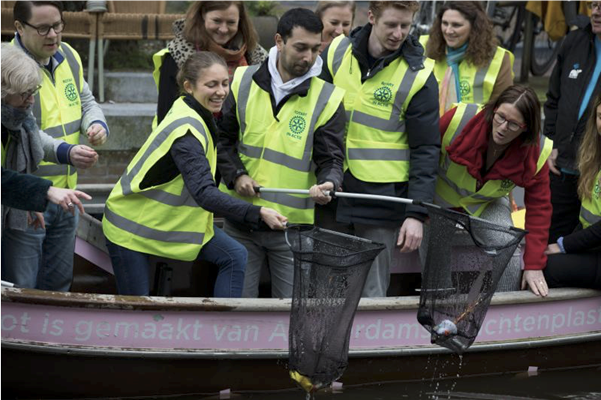
Dutch Rotarians have been tackling the vexing problem of plastic waste. The End Plastic Soup project started with a cleanup in the canals of Amsterdam and has expanded to collecting and recycling plastics and raising awareness of plastic waste in the Netherlands and nearby countries.
The End Plastic Soup project started with a cleanup in the canals of Amsterdam and has expanded to collecting and recycling plastics and raising awareness of plastic waste in the Netherlands and nearby countries.
In Hawaii, USA, ocean currents that used to deliver enormous evergreen logs of driftwood to the white sands of Kamilo Beach now clutter it with debris, earning “Plastic Beach” the distinction of being one of the dirtiest beaches on earth. Volunteers from the Rotary Club of South Hilo periodically recruit their colleagues and neighbors for cleanup days. During one cleanup last August, volunteers collected 37 bags of trash, 100 pounds of loose plastics and 300 pounds of nets and fishing lines. The club is also working with the Hawai’i Wildlife Fund to divert plastic from landfills.
In Rio Claro, Brazil, waste pickers separate plastics according to their type and sell the material to an intermediary that cleans, grinds, and dries it, then sells it at a profit. Through a Rotary Foundation global grant project of the Rotary clubs of Rio Claro-Alvorada, Brazil, and Longwood, Pennsylvania, the local waste pickers cooperative received equipment to process the plastic itself, meaning a 50 percent income increase and an expansion in the number of waste pickers who can participate.
The Rotary Club of Vero Beach, Florida, USA, is working on a plastic recycling project in its community. In collaboration with the county landfill, the club has placed recycling bins in commercial facilities — such as a brewery and a store at a local outlet mall — to collect the shrink-wrap that their pallets of products are wrapped in. The county then takes the shrink-wrap to a recycling center, which sells it to companies that make plastic furniture and outdoor decking.
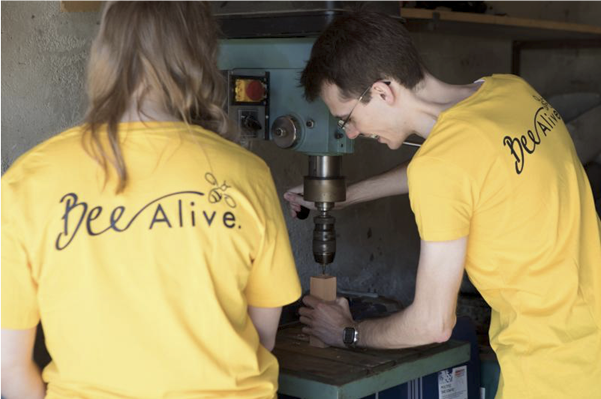
German Rotaract clubs and their sponsoring Rotary clubs have been working to educate people about the importance of bees to our environment. The club members are taking steps to stem the bees’ decline, including by building wooden “bee hotels” where wild bees can safely make their nests and lay eggs. Bee populations have been declining because of the widespread use of toxic pesticides, the practice of growing a single crop in given area, and climate change. But bees play a vital role in the ecosystem.
German Rotaract clubs and their sponsoring Rotary clubs have been working to educate people about the importance of bees to our environment. Members make bee hotels to help the wild bees survive.
The Rotary clubs of Leogane, Haiti, and Parker, Colorado, led a global grant project to install a hybrid solar, diesel, and grid power system. The school saved $4,000 a year in fuel costs and reduced air and noise pollution. The hybrid system also powers interior and exterior lighting, computers, fans, and educational tools. A new water distribution system, which uses the hybrid power, and a literacy program were also part of the grant.
The Rotary clubs of Leogane, Haiti, and Parker, Colorado, led a global grant project to install a hybrid solar, diesel, and grid power system.
A global grant project of the Rotary clubs of Taipei Lungmen, Taiwan, and Patumwan, Thailand, trained 40 people from Meihua village in organic farming techniques. The effort, carried out in partnership with the Organic Farming Association of Taiwan, included creating a training facility and providing internships at organic farms. The agriculture practices include avoiding the use of plows to keep from disturbing the soil; planting a diverse array of cover crops; and limiting or abstaining from pesticides and synthetic fertilizers. These methods boost the amount of organic matter — carbon — in the soil, improving its health and that of the plants growing in it.
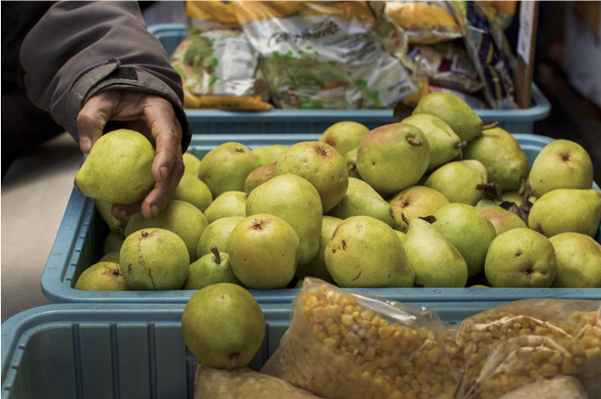
The Rotary clubs of Bucaramanga Nuevo Milenio, Colombia, and Woodland Hills, California, are working with a food wholesaler in Bucaramanga to reduce food waste by 15 percent. The wholesaler generates about 20 tons of organic solid waste per day. Under the grant a center will be set up to use the surplus produce to provide training in safe food handling and processing while creating employment opportunities.
Rotary members in Colombia have been working to reduce food waste.
The Rotary clubs of Antananarivo-Tsimbaroa, Madagascar; Torino Mole Antonelliana, Italy; and Annecy Tournette, France, partnered with a local nonprofit on a project to reforest about 125 acres with native species grown from wild seed, creating jobs for area families and a tourism infrastructure. Rotarians also trained women in gardening techniques, constructed toilets, and provided 500 improved cookstoves that reduced the families’ dependence on charcoal.
The Rotaract Club of Tagbilaran, on the island of Bohol, Philippines, is focusing on the issue of single-use plastics. Working with Fablab Bohol Philippines, the country’s first state-of-the-art digital fabrication laboratory, members of the club designed prototypes for souvenir items made of recycled spoons from nearby ice cream shops. The project won an award during a national Rotaract competition. The club also is working to reduce plastic straw use by selling metal straws in a locally handcrafted pouch.
This year, Leanne Byron’s 2024-2025 Rotary District Governor Partner Project is raising funds to support the Monash Children's Cancer Centre, a remarkable institution dedicated to helping children with cancer.
The goal is to raise $100,000 to train an in-house Apheresis Clinical Nurse Consultant who will provide life-saving treatments. While it’s a significant sum, this support can make a profound difference for many children, offering them not just a chance at life but a brighter future.
Monash Children's Hospital already has the equipment, facilities and medical expertise to provide Apheresis Therapy to our young patients, but the key is in the in-house Apheresis Clinical Nurse Consultant to unlock the delivery of the program. Apheresis therapy will also be a vital part of delivering personalised "Precision medicine", which is the future of cancer treatment. That future isn't far away, and providing this specialised nursing role now will equip Monash Children's Hospital for many years to come.
Please help us fund a specialist Apheresis Nurse to improve the quality of care and survival chances for children with high-risk cancers.
A fundraiser event is planned for April 30th 2025 at:
Shangri-La Inn Malaysian & Chinese Restaurant 37-39 Brentwood Square Forest Hill 3131 Wednesday April 30th - 6:30pm for 7pm start 9 course meal COST: $65 per head
Amplifying impactRotary and our sister magazines are a key player in rallying Rotary clubs globally, helping raise awareness and funds to support our causes.Mykola
Thousands set to gather in Calgary for Rotary’s international convention, one of the ‘Blue Sky City’s’ most multicultural events to dateRotary members from 120 countries