Posted by Sam McCurdy:
I have compiled this article from scientific information gleaned from various sources, as I feel it supports Rotary's seventh area of focus "Supporting the Environment". I would be interested in receiving your feedback on its contents.
On average, rooftops take up 25% of a city’s land area... that's a whole lot of space with the potential for activation or utilisation. In major cities, they are increasingly being employed to generate lasting benefits for communities and residents from playgrounds, to urban farms, to solar green roofs, and extended living spaces.
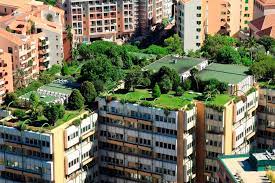
A green roof is a vegetated cover, or a permanent rooftop planting system covering a significant portion of a building's roof. They mitigate stormwater run-off, reduce the urban heat island effect and increase biodiversity.
FACT: Did you know green roofs have been mandatory for newly developed buildings in Copenhagen since 2010?
FACT: Did you know green roofs have been mandatory for newly developed buildings in Copenhagen since 2010?
So, what is behind this trend? Each year summers are getting hotter (we're all feeling it 🥵) and it is becoming widely apparent that trees act as “natural air conditioning units”.
The origins of green roofs began thousands of years ago. The most famous green roofs were the Hanging Gardens of Babylon. They were considered as one of the Seven Wonders of the Ancient World and were constructed around 500 B.C. They were built over arched stone beams and waterproofed with layers of reeds and thick tar. Plants and trees were then planted.
In more recent times, people used sod to cover their roof tops for the purpose of insulation, it kept their homes cool in summer and warm in winter. Modern green roofs may have had their "roots" in ancient times, but technological advances have made them far more efficient and expensive than their ancient counterparts.
A green roof reduces cooling loads on a building by fifty to ninety percent, especially if it is glassed-in so as to act as a terrarium and a passive solar heat reservoir. A practical example of this - in New York the coolest parts of the city are all adjacent to major parks (temperatures can be up to 10 degrees cooler inside a park compared to surrounding spaces of concrete streets and buildings).
A recent study in Sydney compared two almost identical roofs - both had solar panels, but one had a "green roof" with plants and foliage in and around the solar panels. The study found that on hot days "surface temperatures were up to 20 degrees Celsius lower on the green roof, as compared to the standard solar roof"! As a result, 9.5MWH more renewable energy was generated on the green roof (because PV solar panels work less efficiently when they are hotter).
When designing your next energy efficient home, it may be useful to consider this information.